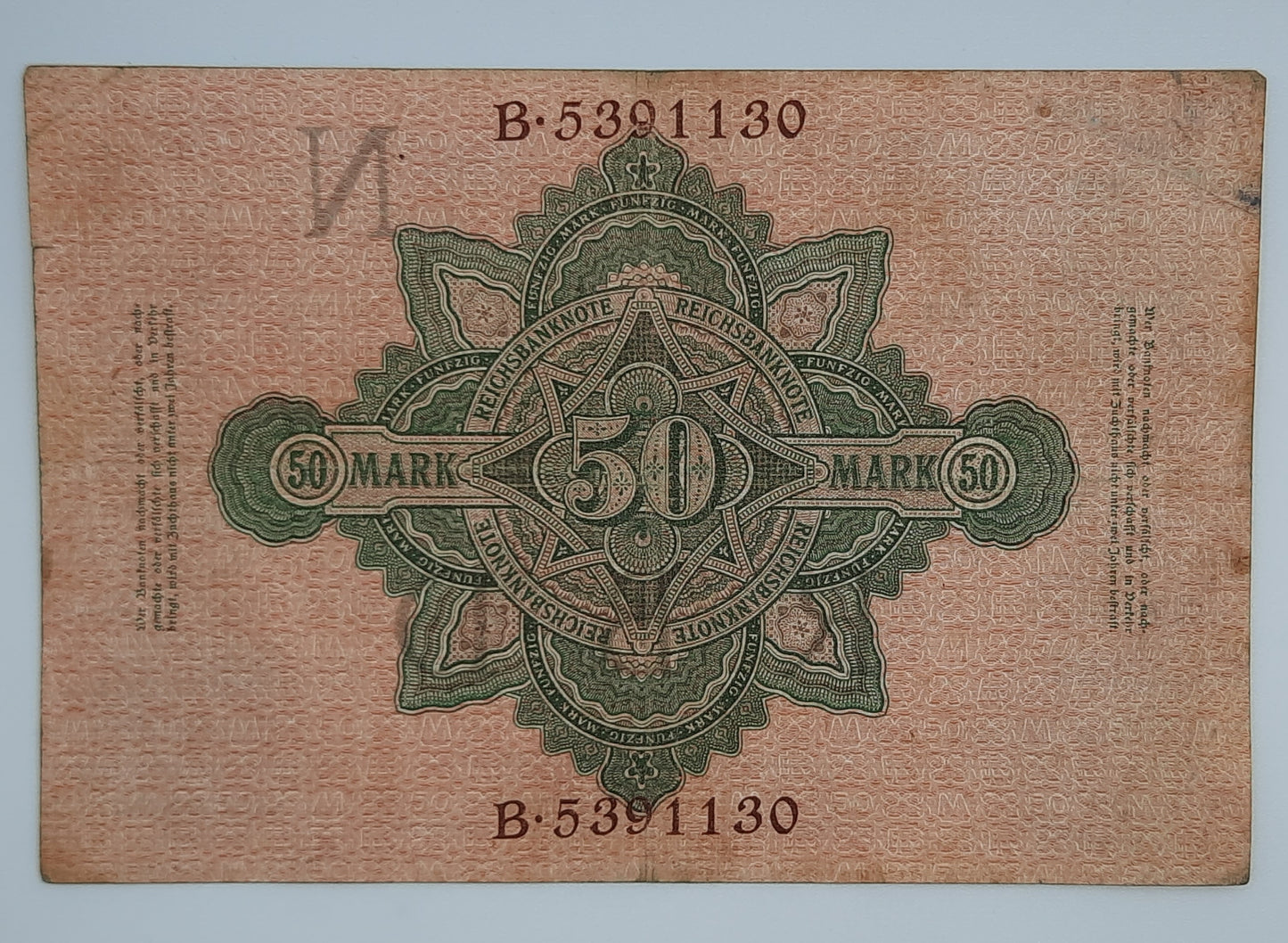
1910 Germany 50 Mark Banknote – Imperial Era Issue
A Pre‑WWI Reichsbank Note Showcasing Classical Allegory & High‑Art Engraving
The 1910 Germany 50 Mark banknote is one of the most elegant and recognisable issues of the late German Empire (Deutsches Kaiserreich). Printed during the reign of Kaiser Wilhelm II, this note reflects the artistic confidence, economic stability, and classical design language of pre‑World War I Germany — a stark contrast to the inflationary chaos that would follow a decade later.
This issue is admired for its large format, deeply detailed engraving, and its allegorical female figure symbolising German prosperity, culture, and national identity. Produced by the Reichsdruckerei in Berlin, the note represents the height of Imperial‑era banknote artistry before the upheavals of war and revolution transformed the nation’s currency.
Collectors prize the 1910 50 Mark for its beauty, historical significance, and its place as one of the last major notes of a stable, gold‑backed German monetary system.
Key Features & Catalogue Details
Attribute Details
Country Germany (German Empire)
Issuer Reichsbank
Denomination 50 Mark
Year of Issue 1910
Pick Number P‑42 (various sub‑types)
Series Imperial Era Issue
Material Paper
Dimensions Large format
Watermark Portrait or geometric pattern (varies by print run)
Printer Reichsdruckerei, Berlin
Theme Allegorical female figure, Imperial symbolism
Design Overview
Obverse – Allegorical Female Figure & Classical Ornamentation
Features a beautifully engraved allegorical female figure, often interpreted as Germania or a personification of abundance and national strength.
Surrounded by intricate scrollwork, rosettes, and guilloche patterns typical of high‑quality early‑20th‑century engraving.
The denomination “Fünfzig Mark” is displayed prominently in ornate lettering.
Deep blue‑green and brown tones give the note a refined, stately appearance.
The design reflects the artistic confidence of the German Empire at its peak, before the disruptions of war and inflation.
Reverse – Symmetry, Guilloches & Imperial Flourishes
Dominated by complex guilloche patterns and symmetrical linework.
Large “50” numerals ensure clear denomination recognition.
Includes Imperial‑era motifs and decorative borders, but no central portrait.
The reverse emphasises balance, precision, and anti‑counterfeit detail — hallmarks of pre‑WWI German printing.
Historical Context
Issued in 1910, this note represents the final years of:
A gold‑backed, stable German currency
The unified German Empire under Kaiser Wilhelm II
A period of industrial expansion and cultural confidence
Within just a few years, the outbreak of World War I (1914) would force Germany off the gold standard, trigger massive war borrowing, and set the stage for the inflationary spiral of the early 1920s.
The 1910 50 Mark note therefore stands as:
A symbol of pre‑war economic stability
One of the last major notes of the Imperial monetary system
A beautifully engraved example of early‑20th‑century German craftsmanship
A snapshot of the world before the political and economic upheavals that reshaped Europe
Collector Appeal
Collectors value the 1910 50 Mark for its:
Exceptional engraving and classical allegory
Large, visually impressive format
Connection to the German Empire before WWI
High artistic quality compared to later emergency and inflation issues
Historical significance as a pre‑inflation, pre‑Reichsbanknote transition piece
This note remains one of the most attractive and culturally meaningful pieces of Imperial German paper money.