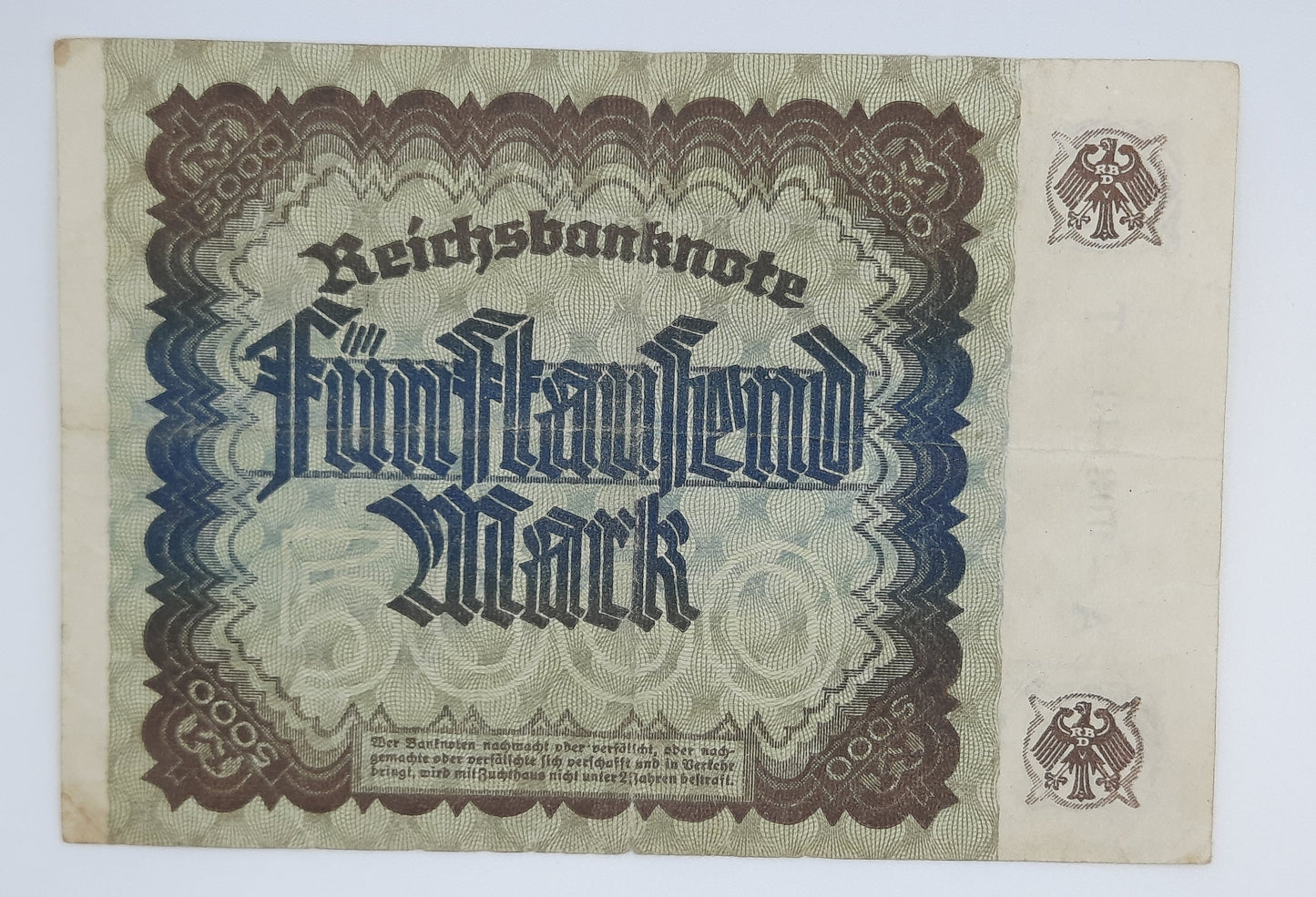
1922 Germany 5,000 Mark Banknote – P‑81a
A Weimar‑Era Inflation Note Featuring Martin Luther & Ornate Early‑1920s Engraving
The 1922 Germany 5,000 Mark banknote (Pick 81a) is a key early‑inflation issue from the Weimar Republic, printed as Germany struggled with rising prices and post‑war economic instability. This note is instantly recognisable for its engraved portrait of Martin Luther, the central figure of the Protestant Reformation, making it one of the most historically meaningful designs of the early inflation period.
Issued before the catastrophic hyperinflation of late 1923, the 5,000 Mark note represents a transitional moment — when denominations were rising quickly, but the currency had not yet collapsed into the billions and trillions.
Collectors value this note for its strong historical context, large format, and the prominent depiction of one of Europe’s most influential religious and cultural figures.
Key Features & Catalogue Details
Attribute Details
Country Germany (Weimar Republic)
Issuer Reichsbank
Denomination 5,000 Mark
Year of Issue 1922
Pick Number P‑81a
Series Early Inflation Issue
Material Paper
Dimensions Large format
Watermark Geometric pattern
Printer Reichsdruckerei, Berlin
Theme Martin Luther & early inflation currency
Design Overview
Obverse – Portrait of Martin Luther
Features a finely engraved portrait of Martin Luther, based on classical 16th‑century depictions.
Surrounded by ornate scrollwork and guilloche patterns typical of early Weimar engraving.
Bold “Fünftausend Mark” denomination printed prominently.
Rich brown‑olive colour palette gives the note a dignified, historical appearance.
This side connects Germany’s turbulent 1920s economy with one of its most important cultural and religious figures.
Reverse – Ornamental Guilloches & Large Denomination
Displays elaborate guilloche patterns and symmetrical linework.
Large “5000” numerals dominate the design for quick recognition during inflation.
Clean, balanced layout with no central vignette.
The reverse emphasises clarity and anti‑counterfeit detail during a period of rapid reprinting.
Historical Context
By 1922, Germany was entering the early stages of inflation driven by:
War reparations
Political instability
Industrial disruption
Currency devaluation
The 5,000 Mark note was introduced as prices rose faster than existing denominations could handle. Within a year, even millions and billions of marks would become commonplace.
Collectors value the P‑81a because it represents:
The early phase of Weimar inflation
A large, beautifully engraved note
A rare instance of Martin Luther on German currency
A historically pivotal moment in European monetary history