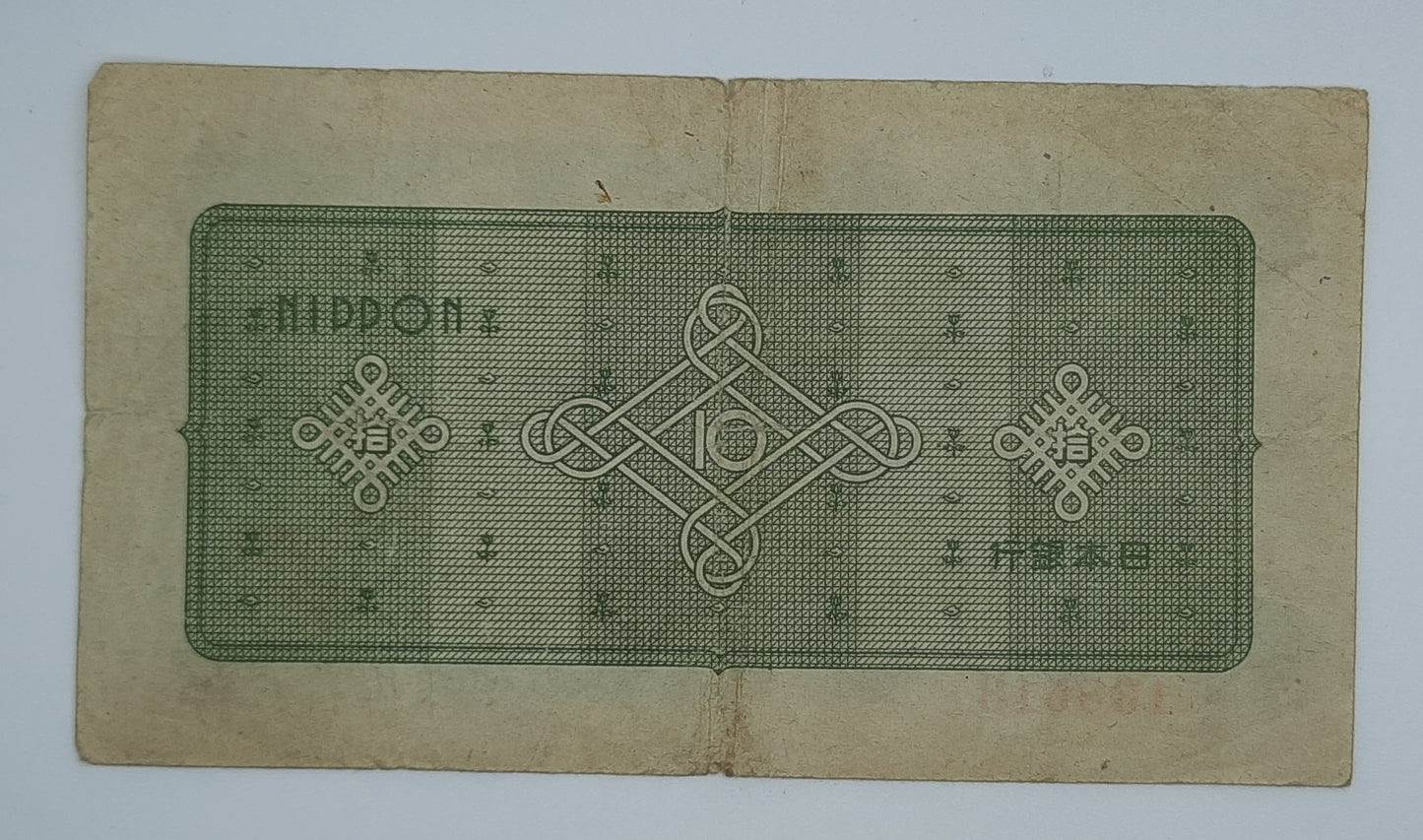
Japan 10 Yen Banknote – National Diet Building & Imperial Seal (1946 Issue)
Historical context
Released on 25 February 1946, this note belongs to Japan’s first major post‑WWII currency issues. It circulated during a period of economic instability, reconstruction, and political reform. The design reflects Japan’s shift toward modern governance while retaining imperial symbolism.
Obverse design
The front of the note features a strong architectural and symbolic composition:
National Diet Building in Nagata‑chō, Tokyo — the centre of Japan’s parliamentary government
Imperial Seal of Japan (kikukamon) — a stylised chrysanthemum blossom symbolising the Emperor
Stylised cockerel (rooster) — a traditional motif associated with vigilance and renewal
Denomination and issuing authority in Japanese script
Text reading Nippon Ginkō (Bank of Japan) and Jū En (Ten Yen)
The colour scheme is blue on a multicolour underprint, typical of early post‑war issues.
Reverse design
The reverse uses a clean, symmetrical layout:
Decorative guilloche patterns
Denomination in large numerals
“Nippon” in English and Japanese
Simple, secure design reflecting the printing limitations of the immediate post‑war period
Key specifications
Feature Details
Country Japan
Issuer Bank of Japan
Emperor Shōwa (Hirohito)
Type Standard circulation banknote
Year 1946
Issue date 25 February 1946
Denomination 10 Yen
Currency Yen (1871–present)
Composition Paper
Size 139 × 77 mm
Shape Rectangular
Scripts Japanese, Latin
Watermark None (typical for this emergency‑era issue)
References Pick 87, JNDA 11‑65
Demonetized Yes
Issue suspended 1 April 1955
Artistic and cultural significance
This note captures Japan at a turning point:
The National Diet Building symbolises the new democratic framework emerging after the war.
The Imperial Seal maintains continuity with centuries of tradition.
The rooster motif reflects renewal and vigilance during reconstruction.
Its blend of modern state imagery and imperial symbolism makes it a unique transitional design.
Collecting appeal
Collectors value the 1946 10 yen note for:
Its role in Japan’s early post‑war monetary system
The prominent depiction of the National Diet Building
Its short circulation period before suspension in 1955
Its affordability in lower grades and rising value in crisp examples
It remains a foundational piece for anyone building a collection of Japanese WWII and post‑war currency.