1968 Netherlands 10 Gulden Banknote – Dutch Modernism and the Legacy of Frans Hals
Pick# 91 | Plomp# PL47 | De Nederlandsche Bank
The 1968 Netherlands 10 Gulden note (Pick #91) stands as one of the earliest expressions of the Netherlands’ bold transition into modern banknote design. Issued under Queen Juliana and crafted by the visionary designer Ootje Oxenaar, this note bridges Dutch Golden Age heritage with the emerging graphic modernism that would later define Dutch currency for decades. Collectors value it as a landmark piece—both historically and artistically—representing the Netherlands at a moment of cultural confidence and design innovation.
Historical Context
Released in 1968, this 10 Gulden note belongs to a period when the Netherlands was reshaping its visual identity. The country was modernising rapidly, and De Nederlandsche Bank embraced a new design philosophy: banknotes should be secure, functional, and unmistakably Dutch. Oxenaar’s work on P‑91 reflects this shift—combining traditional portraiture with experimental geometry, colour layering, and tactile features.
The note circulated until the introduction of the euro in 2002, making it one of the last representatives of the long‑standing Gulden currency (1817–2001). Today, it stands as a collectible emblem of Dutch design history and national heritage.
Key Specifications
Feature Description
Country Netherlands
Issuer De Nederlandsche Bank
Reigning Monarch Queen Juliana (1948–1980)
Type Standard circulation banknote
Year of Issue 1968
Value 10 Gulden (10 NLG)
Currency Gulden (decimalized)
Material Paper
Size 142 × 76 mm
Shape Rectangular
Watermark Cornucopia (two varieties)
Demonetized 27 January 2002
References P# 91, Plomp# PL47
Design Features
Obverse
A sophisticated blend of dark blue, violet, and multicolour underprint forms the backdrop for a striking portrait of Frans Hals, the celebrated Dutch Golden Age painter known for his lively brushwork and expressive portraits. Positioned on the right, Hals anchors the note in Dutch artistic tradition.
Key elements include:
Portrait of Frans Hals (1582/83–1666)
Tactile mark: three raised dots in the lower left corner, an early accessibility feature
Latin script lettering, including:
“amsterdam 25 april 1968”
“de nederlandsche bank”
“TIEN GULDEN 10”
Engraver: Ootje Oxenaar, whose signature design philosophy shaped Dutch currency for decades
The obverse balances heritage with modernity, using layered colour fields and crisp typography to create a note that feels both classical and contemporary.
Reverse
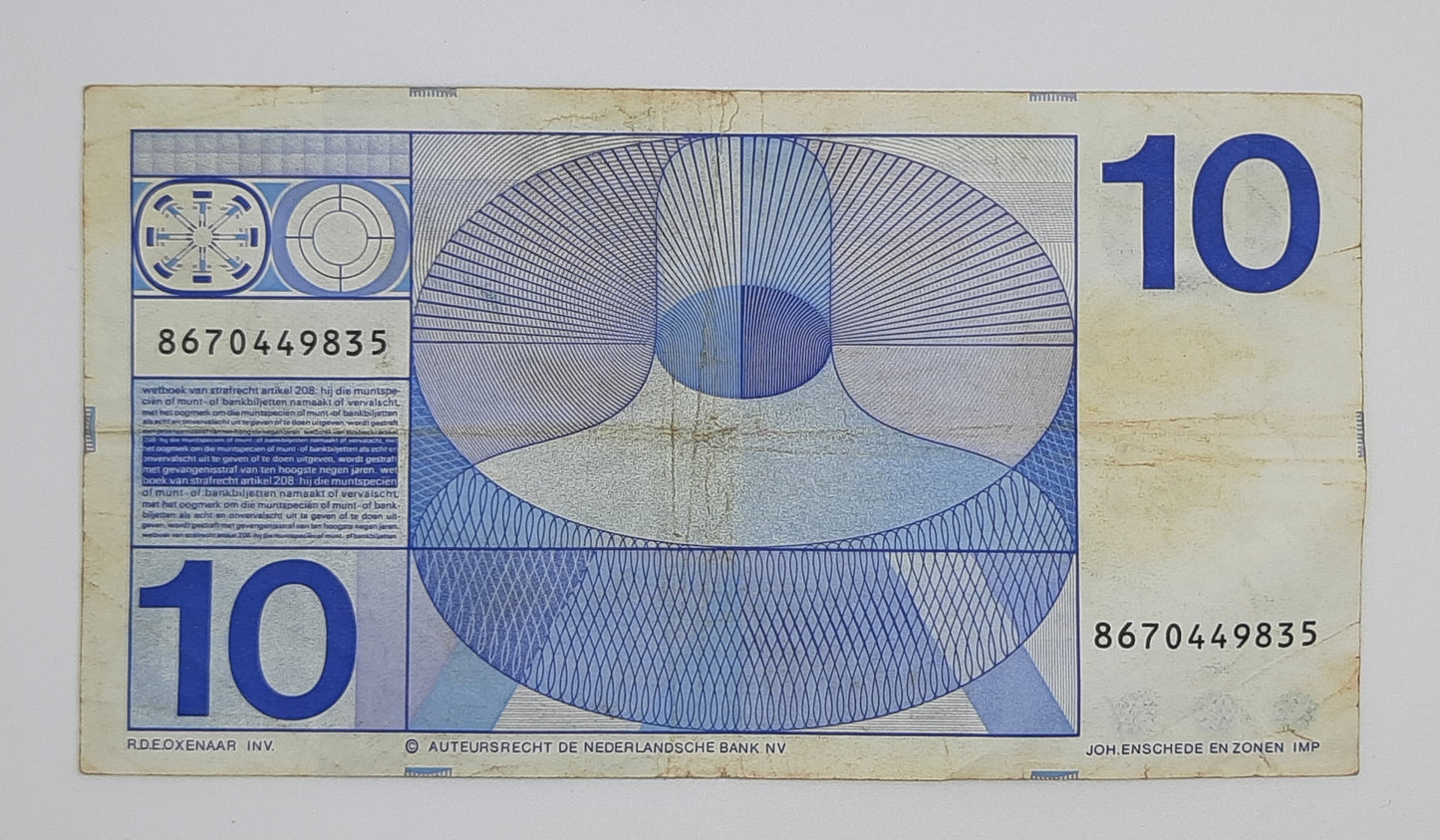
The reverse continues the modernist aesthetic with a stylized cylinder, a geometric motif characteristic of Oxenaar’s experimental approach. The design is clean, abstract, and unmistakably Dutch in its precision.
Lettering includes:
The denomination 10
A full excerpt from Criminal Code Article 208, warning against counterfeiting
Designer and copyright credits:
R.D.E. Oxenaar inv.
© Auteursrecht De Nederlandsche Bank NV
Joh. Enschedé en Zonen Imp (the historic Dutch security printer)
The reverse’s minimalist geometry contrasts beautifully with the portrait‑driven obverse, making the note visually compelling from both sides.
Collector Appeal
The 1968 10 Gulden (P‑91) is highly regarded among collectors of European and modernist banknotes for several reasons:
Oxenaar’s Early Mastery This note marks the beginning of the designer’s influential career in Dutch currency, making it a foundational piece for design‑focused collections.
Golden Age Heritage The portrait of Frans Hals connects the note to one of the Netherlands’ most celebrated artistic eras.
Modernist Innovation The stylized cylinder and layered colour palette reflect the Netherlands’ pioneering role in graphic design.
Pre‑Euro Legacy As part of the Gulden’s final decades, the note represents a currency with nearly two centuries of history.
Tactile Features The three‑dot tactile mark is an early example of inclusive design in European banknotes.
Why Add the 1968 Netherlands 10 Gulden (P‑91) to Your Collection?
This note is more than a monetary artifact—it is a statement of Dutch identity, artistic heritage, and design innovation. The combination of Frans Hals’ portrait, Oxenaar’s modernist geometry, and the Gulden’s long historical lineage makes P‑91 a standout piece for collectors on platforms such as Numista, Notaphily, or notescounter.co.uk.
Whether you collect by theme (art, modernism, European currency) or by designer, the 1968 10 Gulden offers exceptional visual appeal, historical depth, and cultural significance.